
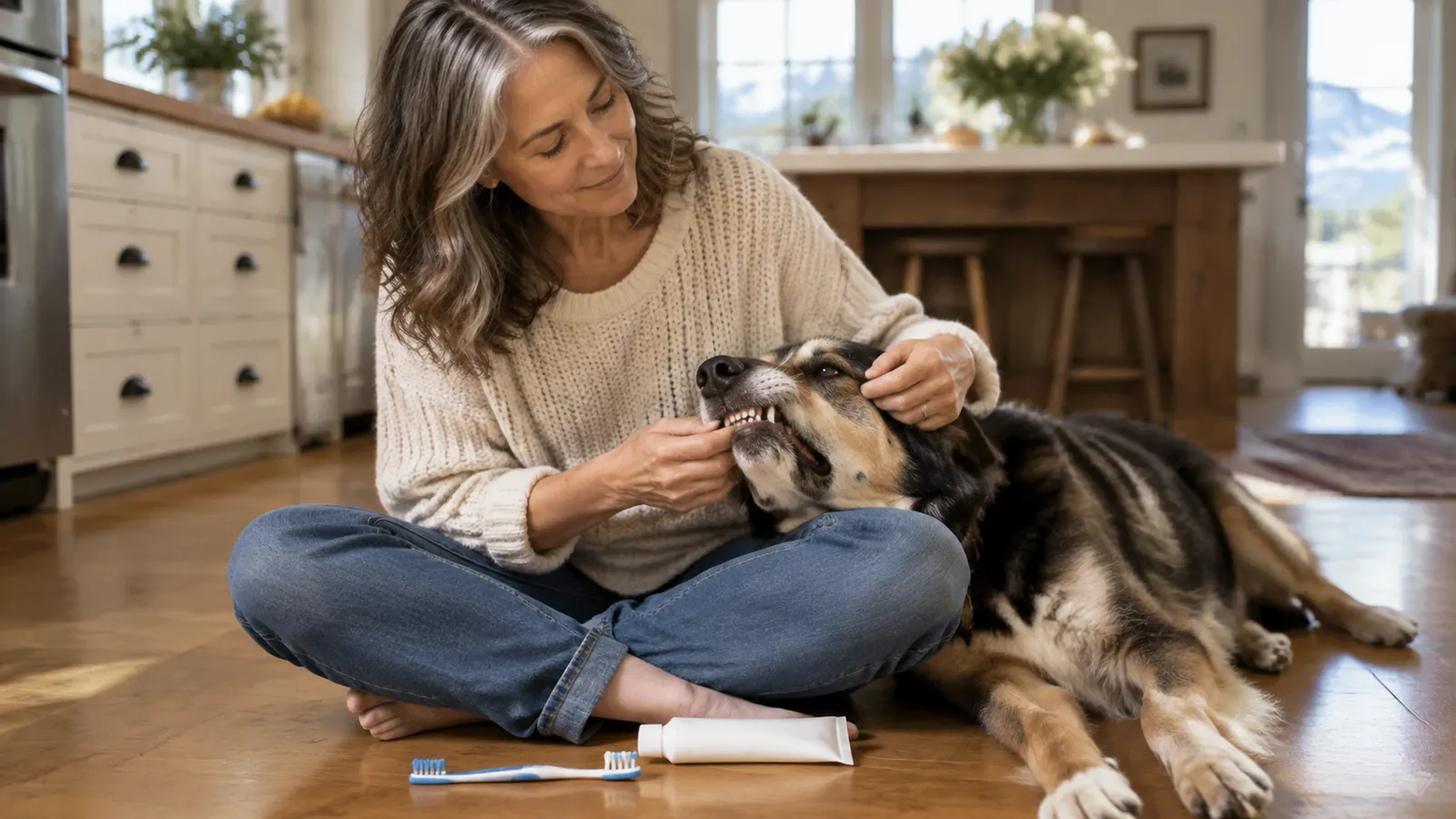
Two years ago, when Juno was six, her breath turned sour. She is a lab and hound mix, a sturdy 62 pounds, and when she laid her head on my knee after a walk I caught a whiff of something that made me lean back. At her checkup that spring, my vet, who runs a small two room practice twenty minutes from my house, looked at her back teeth and said what I already suspected. Plaque was building up along her gumline. She told me she did not need a dental cleaning yet, but if I wanted to keep her teeth healthy without one, the work had to happen at home. That visit sent me down a long path of toothbrushes, rinses, chew toys, and dental treats like Greenies. Two years later Juno is eight, and she still has not needed a dental cleaning. This is the routine that got us there.
I am not a veterinarian and I am not going to pretend to be one. What I am is a dog owner who sat through the same lecture many of you have heard and then went home to figure out what fits into real life. My vet explained that dental disease is one of the most common problems she treats, and it is far easier to prevent than to fix. She also said a dog's mouth does not need to be perfect, it needs to be tended to most days in small ways that add up. That is the spirit of this guide.
Start With the Chew Juno Looks Forward To
After two years of trying things, the one product that stayed is the Greenies Large dental chew. Juno gets one after her last meal every night, so the 24 count bag lasts us about three and a half weeks. It carries the Veterinary Oral Health Council seal that my vet told me to look for, and it is the anchor of the whole routine. If you change one thing tonight, make it this one.
Amazon Check Today's Price on Amazon →The Five Pieces of Our Routine
I did not build this routine all at once. Each piece took a couple of weeks to feel normal, and each one does a different job. Here is the order I would add them if I were starting over.
Step 1: Let Your Dog Make Friends With the Toothbrush
If your dog fights the toothbrush, you are not doing it wrong, you are just moving too fast. Juno turned her head away the first time she saw the brush, the same way she turns away from the nail clippers. Forcing it would have made everything worse. So I went back to the very beginning and made friends with her mouth first, a few seconds at a time, always after our evening walk when she was already tired and lying down.
I used a soft toothbrush made for dogs and toothpaste in a flavor she actually likes. Poultry, if you are curious. A word on the paste: use only toothpaste made for dogs, because human toothpaste has ingredients that are not safe for a dog to swallow. During the first week I barely brushed at all. I let her lick the paste off my finger and then rubbed along her upper gumline in small circles, exactly where the vet had pointed at the plaque. I stopped while she was still willing, before she could decide she wanted to wriggle away.
About three weeks in, something clicked. Juno started leaning into the brushing the way she leans into a good belly rub, and I could work my way around all four sides of her mouth. I still cannot brush the inside of her teeth well, and my vet says that is normal because a dog's tongue keeps that surface fairly clean on its own. The goal is not a perfect polish. It is a daily interruption of the plaque that would otherwise turn into tartar.
Step 2: Give a Dental Chew Every Single Day
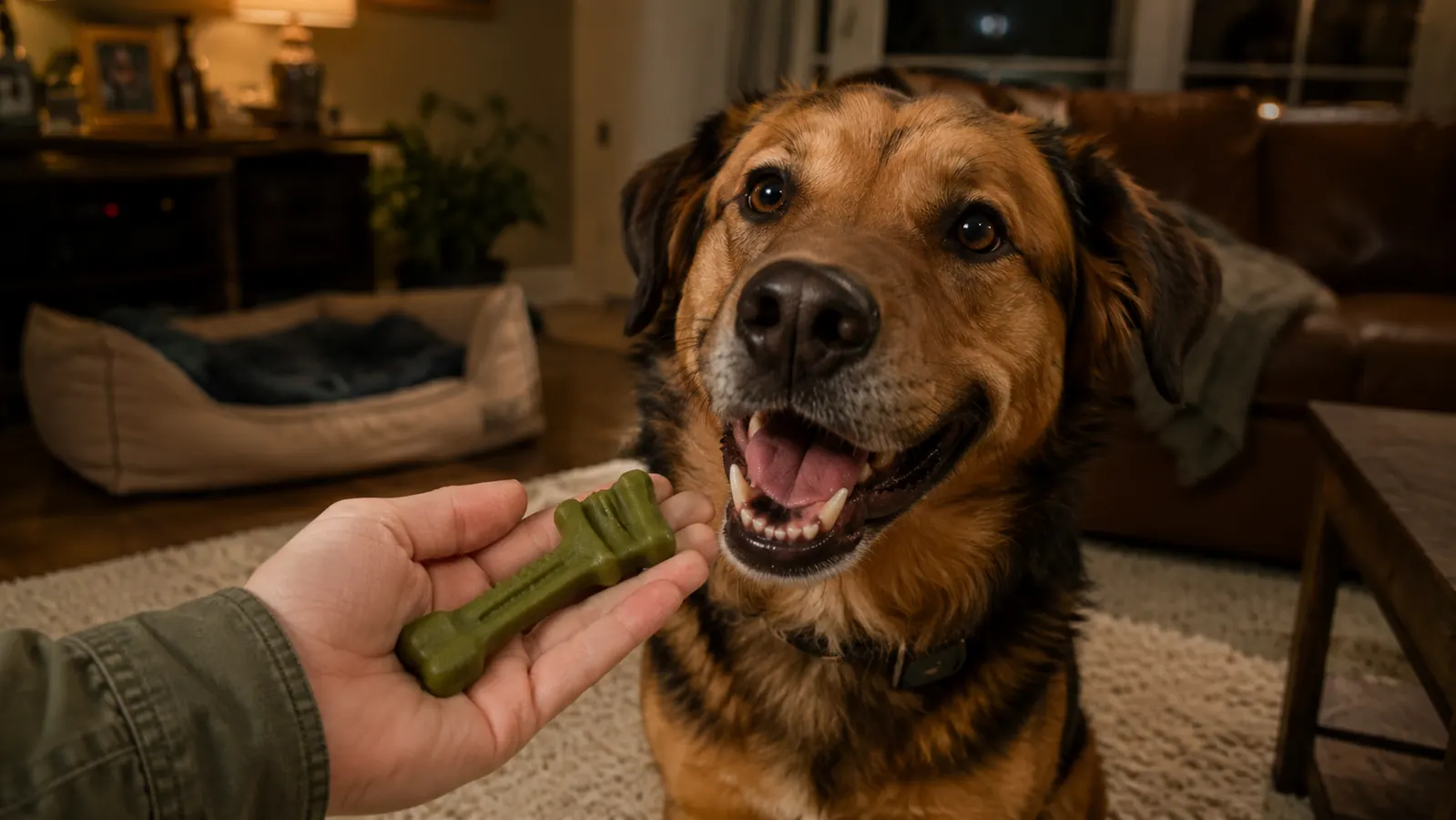
Brushing handles the parts of the teeth I can reach, but the back molars have deep grooves that a brush barely touches. Those get cleaned by chewing. That is where the daily dental chew comes in. Juno gets one Greenies Large dental chew every evening after her last meal, in the same spot on the rug, while I tidy the kitchen. The routine matters as much as the chew itself.
I chose Greenies for a reason. My vet told me to look for the Veterinary Oral Health Council seal on the package, and Greenies carries it, which means the claim that the chew helps control plaque and tartar is backed by studies instead of just packaging. The chewy texture rubs against the teeth while the dog gnaws, and the ridges reach places the brush cannot easily get to. Juno takes her time with it, and that slow chewing is exactly what makes it work.
One practical note. The chew is designed for large dogs, and Juno is 62 pounds, squarely in range for the Large size. I give her one a day, never more, and I watch her for the first few minutes because she can be a gulper with other treats. As she works, the chew softens, and when she finally walks over to her bed I know the day is done. This has been our evening signal for two years.
Step 3: Add a Rinse or Gel for the Gumline
Even with a cooperative dog, a brush has a hard time reaching the gumline at the very back of the mouth, and that is exactly where Juno's problems first showed up. A dental rinse or gel can reach that space. My vet suggested one after her checkup and warned me that some dogs hate the sensation. Juno turned out to be one of those dogs.
The rinse came with an applicator. I lifted her lip, squeezed, and she looked at me as if I had poured water down her ear. We tried it for a week and it was a battle every single time, so we stopped. What worked better was a dental gel I dabbed onto a piece of gauze and wiped along her gumline after brushing. Same idea, far fewer fireworks.
If your dog accepts a rinse or gel, use it right after brushing, when the teeth are already clean, so it can do its work on the gumline. If your dog fights it the way Juno did, skip it. We skipped the rinse for more than a year and our progress did not suffer because the brushing and the daily chew were doing the heavy lifting. Treat this step as optional, not essential.
Step 4: Watch What Your Dog Chews On
The right chew toy works like a slow moving toothbrush. The wrong one can crack a tooth in a single chomp. The rule my vet gave me, and the one I now repeat to anyone who asks, is simple. If you cannot make a dent in something with your thumbnail, it is too hard for your dog's teeth. Real bones, antlers, and hard plastic chew toys have no place in our house.
I look for rubber toys that give a little when squeezed, usually ones with rounded nubs or ridges, plus a good rope toy for tug. Juno's favorite is a thick rubber ring with soft bumps. Fifteen minutes of tug and gnaw is plenty, and I rotate the toys so she does not fixate on one and wear her teeth down unevenly. About once a month I check every toy for rough edges and throw out anything that feels sharp.
The same thinking applies to food. Juno eats regular kibble, and I know a crunchy nugget does not scrub teeth the way the bag makes it sound. My vet mentioned that certain dental diets have actual studies behind them, and I will ask her for a specific recommendation if her teeth ever start to backslide. For now the brushing, the chew, and careful toys are doing the job.
Step 5: Keep the Vet in the Loop
Home care lowers the odds that your dog will need a dental cleaning under anesthesia, but it does not make the vet visit optional. Juno sees her vet every year, and every visit includes the same ritual. She pulls out a small mirror and a chart and walks me along her gumline, pointing out what is normal and what is not. I have learned more in those five minutes than in any article I have read.
I also know the signs that mean call the vet now instead of waiting for the next appointment. Breath that stays sour even with daily brushing and chews. Gums that bleed when I brush. Brown crust along the gumline. Drooling, trouble picking up food, or pawing at the mouth. Juno has not had any of those since we started, but I check for them the same way I check her for ticks after a walk.
If your vet does recommend a cleaning, do not ignore it. I used to dread the anesthesia part until my vet explained the whole process, the bloodwork beforehand and the monitoring during. She told me that for most dogs the benefits of a cleaning outweigh the risks. Juno has not needed one yet. I intend to keep it that way, which is exactly why I do the boring home work every single evening.
How Long Until You Notice a Difference
The honest answer is longer than you want it to be. For the first couple of weeks nothing looked different, and I checked Juno's teeth the way a parent checks a loose tooth, expecting a change overnight. What changed first was her behavior. By the end of week two she was letting me brush without a fight, and a better brushing session makes a better outcome.
The visible changes showed up somewhere around the six week mark. The dark line along her back molars looked thinner, and the sour smell was mostly gone. My vet explained that plaque does not disappear overnight, but it stops advancing when it is disrupted every day. That is what this routine does. It holds the line, and the teeth look a little better with every month that passes.
Three weeks into the daily chew, Juno's breath smelled like a dog's breath again. At her next checkup, my vet said her gumline looked calmer than it had the year before.
What Else Helps
If you take one thing from this guide, let it be this. Consistency beats perfection. Brushing three times a week for a year will do more for your dog's teeth than a perfect routine you abandon after ten days. I built Juno's routine on top of something she already expected, our evening wind down, instead of treating it as a chore I had to remember.
A few small details made it stick. I keep the toothbrush and toothpaste in a cup on the bathroom shelf, out of reach of Pepper, my gray cat, who knocks things onto the floor for sport. I keep the bag of Greenies chews in a pantry cabinet where she cannot work the flap open. I replace Juno's toothbrush every few months, writing the date on the handle so I know when it was last swapped.
Give the routine time. The first month feels like a lot of effort for very little visible change. The second month is when the difference starts to show. By the third month the routine is simply what you do every evening, like filling the water bowl or checking that the back door is locked. No single product did this for Juno. Time and repetition did.
Two years in, brushing Juno's teeth takes about ninety seconds, and the Greenies chew does part of the evening work for me. It is not the highlight of her day or mine. It is just something we do, and her mouth is healthier for it. If your dog's breath has started to turn, start with one chew and one calm brushing session tonight, then add from there.
Tonight Is a Good Night to Start
You do not need the whole routine figured out before you begin. Pick up a dog toothbrush, a toothpaste made for dogs, and a 24 count bag of Greenies Large dental chews. Do one small thing tonight and another tomorrow. That is how Juno and I built this routine, and two years later she has still not needed a dental cleaning.
Amazon Check Today's Price on Amazon →