
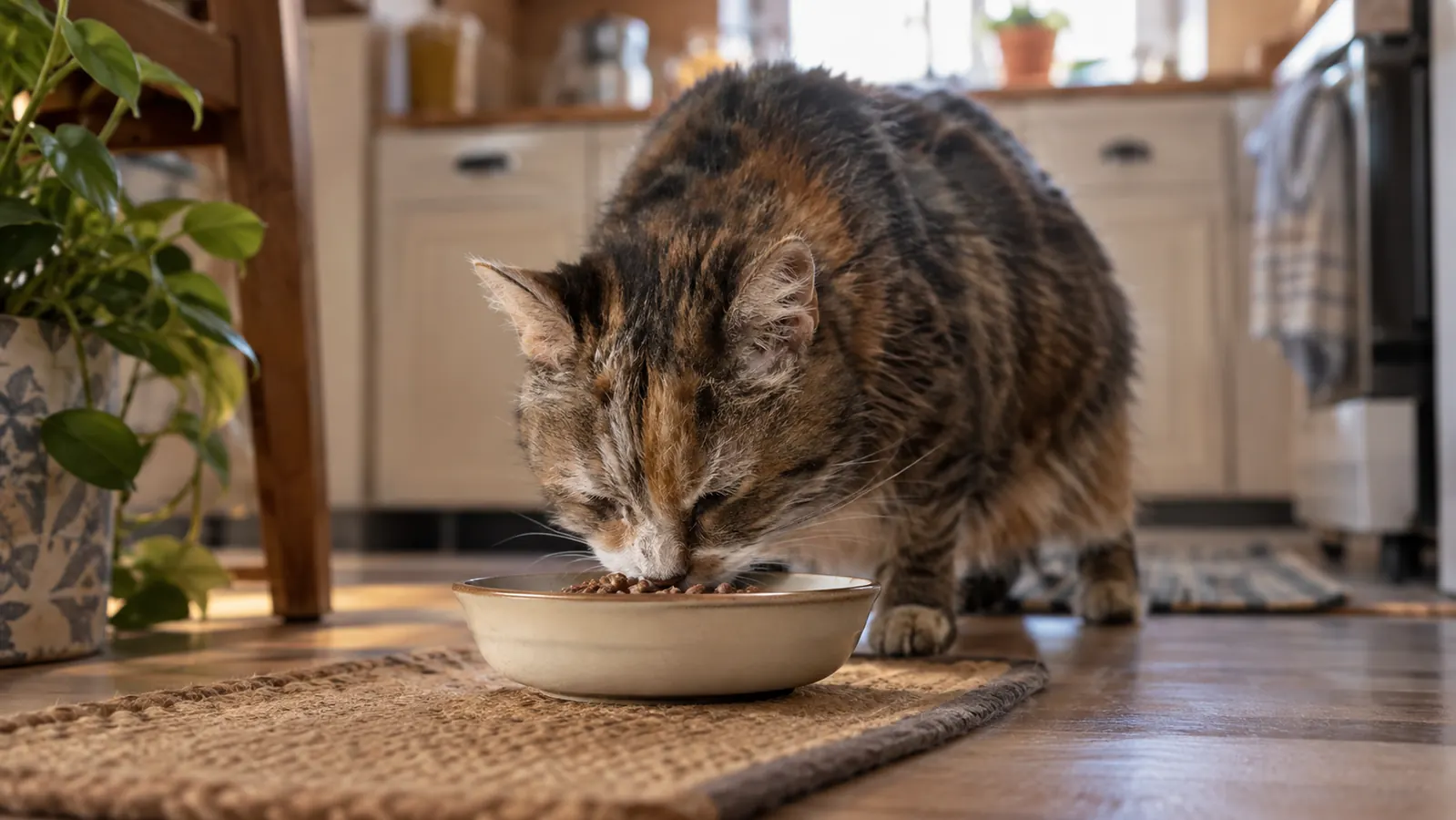
I have an eleven-year-old gray shorthair named Pepper who taught me more about cat stomachs than I ever planned to learn. For most of her life, she ate whatever I set down and cleaned the bowl without drama. Sometime around her ninth birthday, that changed. She started leaving food in the bowl, then she threw up undigested kibble on the hall rug a couple of mornings a week, and her litter box habits went from predictable to something I inspected before anyone else used the bathroom. I know that is more information than you asked for, but if you are reading this because your cat is doing the same thing, you already understand why I brought it up.
I am not a veterinarian, and nothing here replaces one. What I am is a cat owner who kept a careful diary, asked her vet a stack of questions, and tried things one at a time instead of all at once. What finally helped Pepper was ordinary: a clean checkup, a slowed-down food transition, a daily probiotic supplement, a smaller evening meal, and a routine we held for months. The probiotic we landed on was Purina Pro Plan FortiFlora. It mixed into wet food without Pepper noticing, the vet was comfortable with it, and it did not require me to hold a struggling cat still twice a day.
The daily habit that settled Pepper's stomach
A single packet of Purina Pro Plan FortiFlora on top of the evening meal made the difference after about three weeks. Talk to your vet first, then see if it helps your cat.
Amazon Check Today's Price on Amazon →Step 1: Get a checkup before you change anything
The hardest part of a sensitive stomach is figuring out whether the problem is food, hairballs, parasites, or something more serious. Cats hide pain well, and while the occasional hairball is normal, vomiting several times a week, loose stools, or weight loss deserve an actual veterinary visit, not an internet listicle. I made the appointment when Pepper had thrown up three times in seven days. Our vet, a small two-room practice twenty minutes from my house, checked Pepper's teeth, felt her belly, ran a blood panel, and asked a lot of questions about her litter box schedule and eating habits.
Everything came back normal. That might sound like a letdown, but it was exactly what I needed. A clean bill of health meant I could focus on food and routine instead of spiraling into worst-case scenarios. The vet also noted Pepper's weight, which was nine pounds, her age, which was ten at the time, and the fact that her teeth were in good shape for a cat her age. Those details became my baseline, the normal I compared everything against for the next several months.
Take paper or a note app with you to the appointment. I wrote down what the vet said about protein sources, portion sizes, and how fast to change food, because I forget things in the moment. If your vet recommends blood work or an ultrasound, do not skip it to save money. Knowing that there is not a bigger problem is the foundation every other step stands on.
Step 2: Stop switching food overnight
One of the first mistakes I made was buying a new bag of food, dumping it into Pepper's bowl, and expecting her to thank me. Cats have sensitive digestion, and a sudden change in protein and filler can make vomiting and diarrhea worse. The standard advice is to mix the new food with the old over seven to ten days, starting with about a quarter new food and working up very slowly. That feels impossibly slow when you are cleaning the rug at six in the morning, but it is the reason the eventual change actually stuck.
I also learned to read ingredient labels the way I read my own grocery list. For Pepper, a limited-ingredient, high-protein food with fewer questionable additives was easier on her stomach than the budget-friendly kibble I had bought for years. Your cat may do better with a different protein, like rabbit or duck instead of chicken, or with a sensitive-stomach formula from your vet. There is no single right answer. The right answer is the one your cat can eat for three weeks without throwing up, and finding it takes trial and error.
One caution from experience: do not change food and add a probiotic at the same time. If you change two variables at once and your cat gets better or worse, you will have no idea which one caused it. I started with the food change alone, waited until Pepper's stomach settled, and only then added the next step. That is slower, but it is the only way to know what is working.
Step 3: Add a daily probiotic and give it time
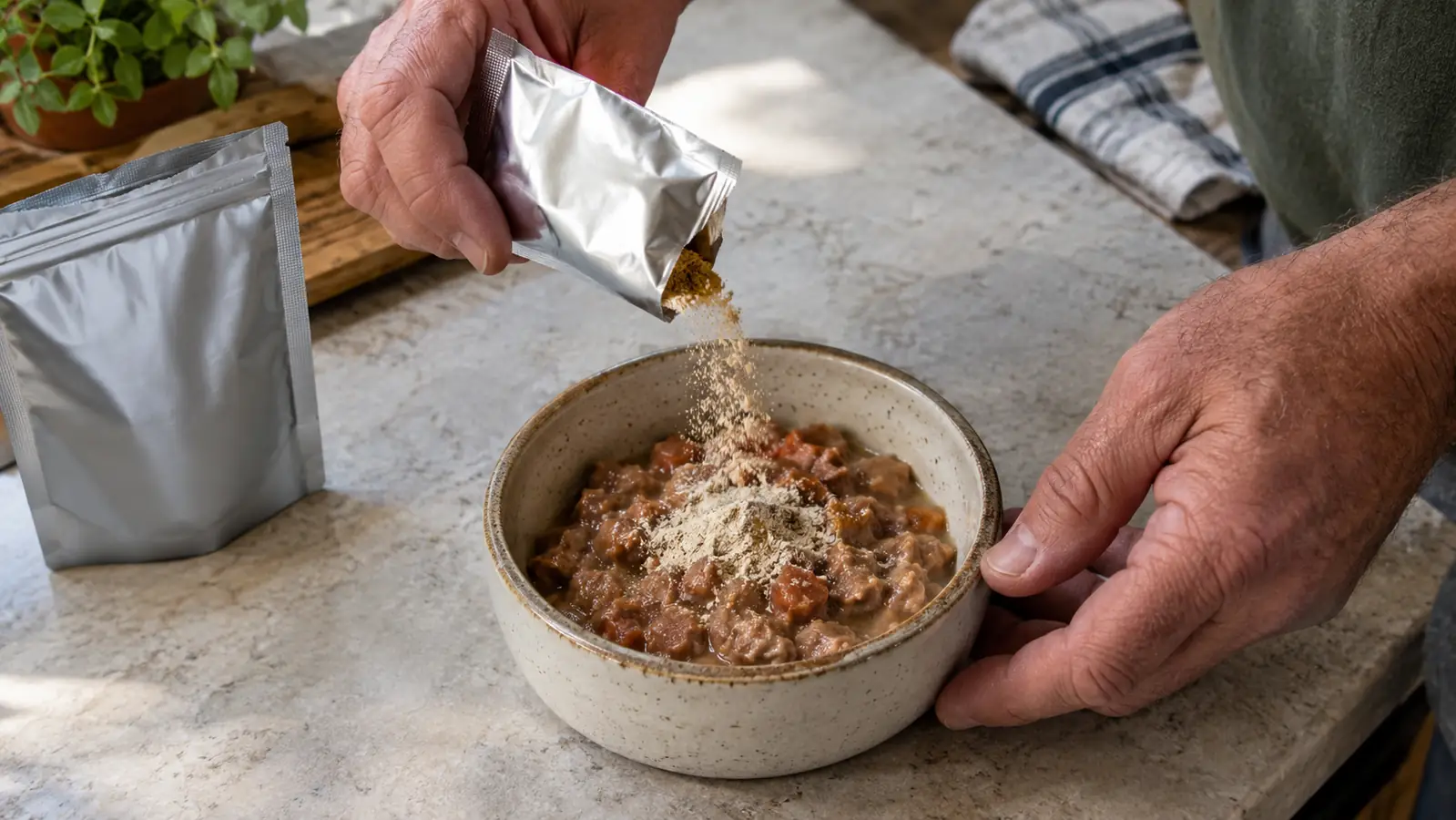
Probiotics are not a quick fix, and anyone who tells you otherwise is selling something. They work by supporting the good bacteria in the gut, and it took about three weeks before I saw a real difference in Pepper. We used Purina Pro Plan FortiFlora, a powder supplement that comes in small foil packets. I emptied one packet onto her wet food every evening. Because the powder is flavored to appeal to cats, Pepper licked the bowl clean, which meant I did not have to fight her to take it.
FortiFlora is sold over the counter, but I still told my vet before I started it. It is designed to be palatable and mixes easily into wet or dry food. For Pepper, it firmed up her stools and cut down on the early-morning vomiting. The key was consistency. I gave it to her every single day for a full month before judging it, and I did not add any other new food or treat during that month. If I had expected a change overnight, I would have given up before the probiotic had a fair chance.
A note about probiotics and illness: a probiotic is a support tool, not a treatment for a sick cat. If your cat is vomiting daily, has bloody diarrhea, or is refusing food entirely, do not reach for a supplement first. Call your vet and follow their instructions. There are conditions like inflammatory bowel disease, food allergies, or parasites that need a proper diagnosis, and the sooner you get that diagnosis, the sooner real treatment can start.
Step 4: Make meals small, scheduled, and predictable
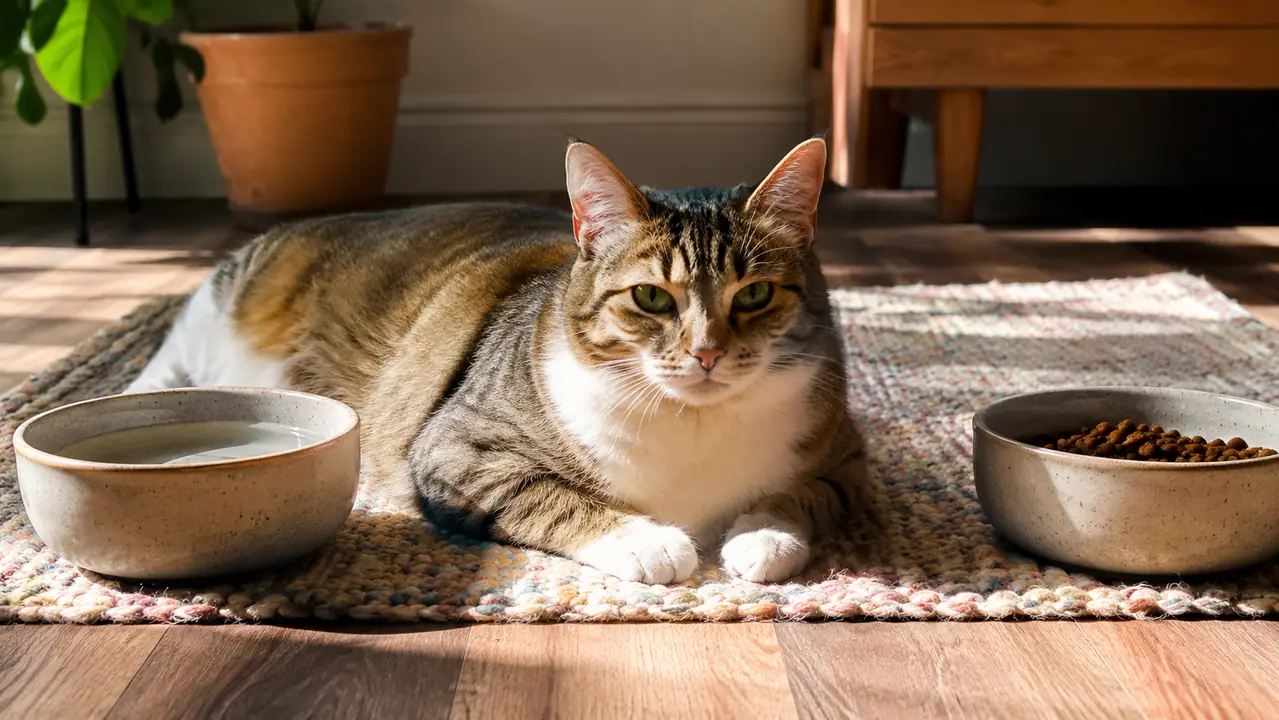
The single biggest shift for Pepper was moving from one big bowl she grazed on all day to smaller meals on a schedule. She gets about a third of a can in the morning, a small portion at midday, and the rest in the evening. That schedule cut down on the eat-too-fast-and-throw-up problem because she was never starving when dinner hit the bowl. It also meant I noticed right away when she did not come running, and losing interest in food is one of the earliest signs that something is off.
Placement matters just as much as timing. Pepper's bowls sit in the same quiet corner of the kitchen, away from the dog bowls and the foot traffic. We have a mixed household, with an eight-year-old lab mix named Juno who would happily eat Pepper's food, so Pepper gets her meals in a spot where Juno is not allowed. I put the bowl down and pick it up on a regular schedule, and I wash the dishes with hot soapy water rather than just rinsing them. Stray bits of old food can harbor bacteria and make a sensitive stomach worse.
I also warmed Pepper's wet food for about ten seconds in the microwave so it gave off a stronger smell. Older cats often have a dulled sense of smell, and if they cannot smell food, they will not eat it, even if their stomach is empty. Just stir it well afterward to avoid hot spots. A cat with a sensitive stomach needs to eat steadily, and making the food appealing is a small way to keep her interested.
Step 5: Keep a diary and track her weight
I started a simple note in my phone with the date, what Pepper ate, whether she threw up, and what her litter box looked like. After two weeks, a pattern emerged. The vomiting mostly happened in the early morning after she had gone too long between meals, and the loose stools lined up perfectly with the days I had given her a bite of my dinner. The diary is what made the probiotic trial honest, because I could look back and see the number of bad days dropping from three a week to one, and then to zero in the fourth week.
Track her weight on the same kitchen scale once a week. Weigh yourself first, then pick up Pepper and weigh yourself again, and subtract the two numbers. A loss of more than half a pound without a clear reason is worth a call to the vet. And if your cat stops eating entirely for more than twenty-four hours, do not wait for the next available appointment. Cats can develop hepatic lipidosis when they stop eating, and that is a serious emergency. I know that is alarming to read, but knowing it is why I called the vet early instead of later.
The diary also helped me see the improvements I would have missed in the day-to-day. The stool quality was a little better by the end of week two. The vomiting was gone by week three. By week six, Pepper was back to grooming herself properly and sleeping in her usual spot instead of hiding under the bed. Those small changes told me the routine was working, even on the days I felt like I was not doing enough.
What Else Helps
Beyond food, probiotics, and a schedule, a few small things made the whole routine easier on both of us. I switched to a wide, shallow bowl so Pepper's whiskers did not brush the sides. Some cats hate whisker fatigue and will refuse to eat when their whiskers are crowded. I also put a second water source in the living room, because cats often do not drink enough when their water bowl sits right next to their food bowl. Keeping her hydrated helped everything else move through more smoothly.
I avoided table scraps, even the ones she begged for, and asked everyone in the house to do the same. People food is one of the quickest ways to upset a cat's stomach, especially fatty or seasoned leftovers. Instead, Pepper gets her daily probiotic packet mixed into her food and an occasional treat made for sensitive stomachs, but I introduced even that slowly and one at a time.
I cannot tell you exactly what will fix your cat, because I am not a vet and every cat is different. What I can tell you is what worked for Pepper: a clean bill of health from the vet, an unhurried food change, a daily probiotic like Purina Pro Plan FortiFlora, and enough routine that her body knew what to expect. If you have an older cat with a sensitive stomach, start with the vet and then be patient. In our house, it took about a month before Pepper seemed like her old self again, and that month of slow, steady changes was worth every minute.
If I had to name the one thing I would tell a friend in the same spot, it is to slow down and keep notes. We live in a culture that wants a pill or a new bag of food to fix things by the weekend, but digestive health does not work that way. It took Pepper about a month to get back to normal, and every change I made, I made one at a time and gave it at least two full weeks. That is not exciting advice, but it is the advice that worked.
About three weeks into the FortiFlora and the smaller meals, Pepper stopped waking me at three in the morning to throw up. That was the week I knew we were on the right track.
Give your cat's stomach a steady routine
Talk to your vet about Purina Pro Plan FortiFlora and see whether a daily probiotic makes sense for your cat. It took about three weeks for us to notice the change, and the consistency was what made the difference.
Amazon Check Today's Price on Amazon →