
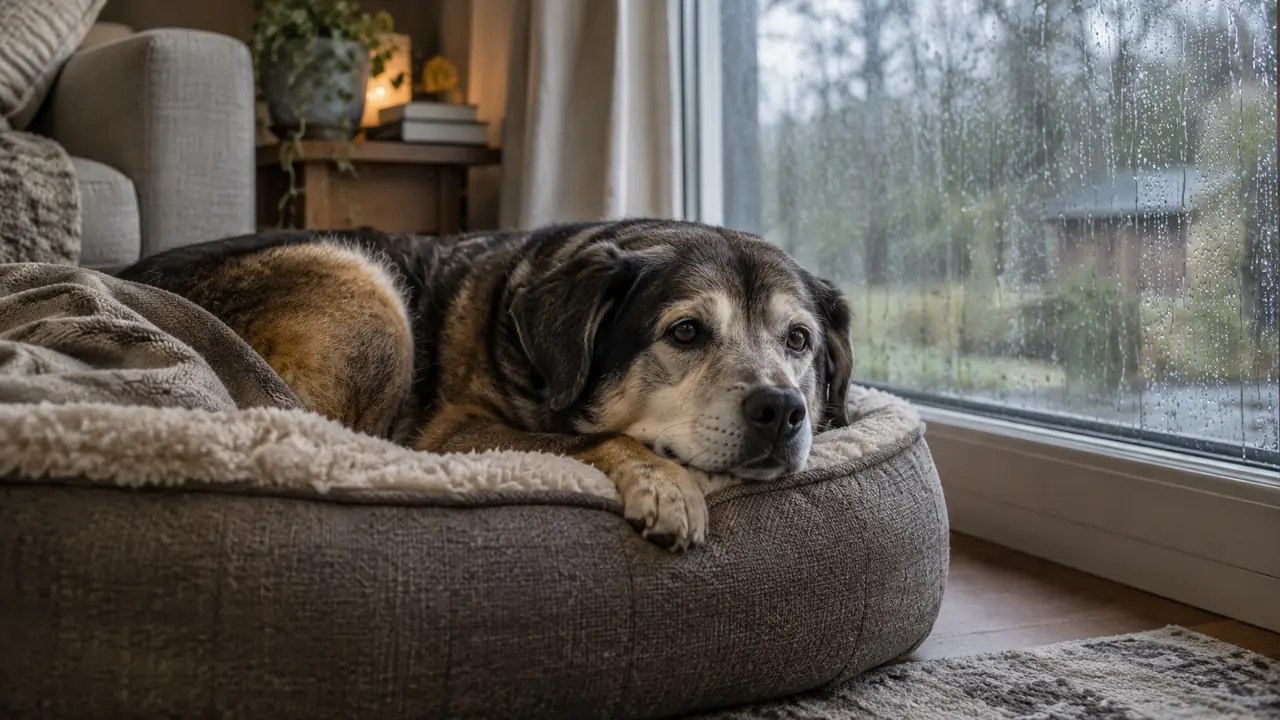
Juno was six the summer I first watched her lose her mind over a thunderstorm. She is a 62 pound mixed breed, lab and hound, built for trail miles, not for crouching behind the couch. That night she paced from the back door to the sofa and back again, nails clicking on the wood floor, panting hard, turning down chicken. My vet, who runs a small two room practice twenty minutes away, told me something I had not expected: anxious behavior in an older dog is often exactly that, behavior, and it deserves the same slow detective work as a limp.
The fix turned out to be a plan, not a product, and the product that earns a place inside the plan is VetriScience Calm & Confident, a chicken flavored chew Juno gets once a day. I want to be honest up front, though: that chew did almost nothing for us until I fixed four other pieces first. If you take one thing from this guide, take that.
Here is the order that worked for us. None of the five steps is expensive, and none of them is complicated on its own. Put together, they are the difference between a dog who rides out a storm in her den and a dog who paces the house until three in the morning.
The Chew That Earned Its Spot in Juno's Routine
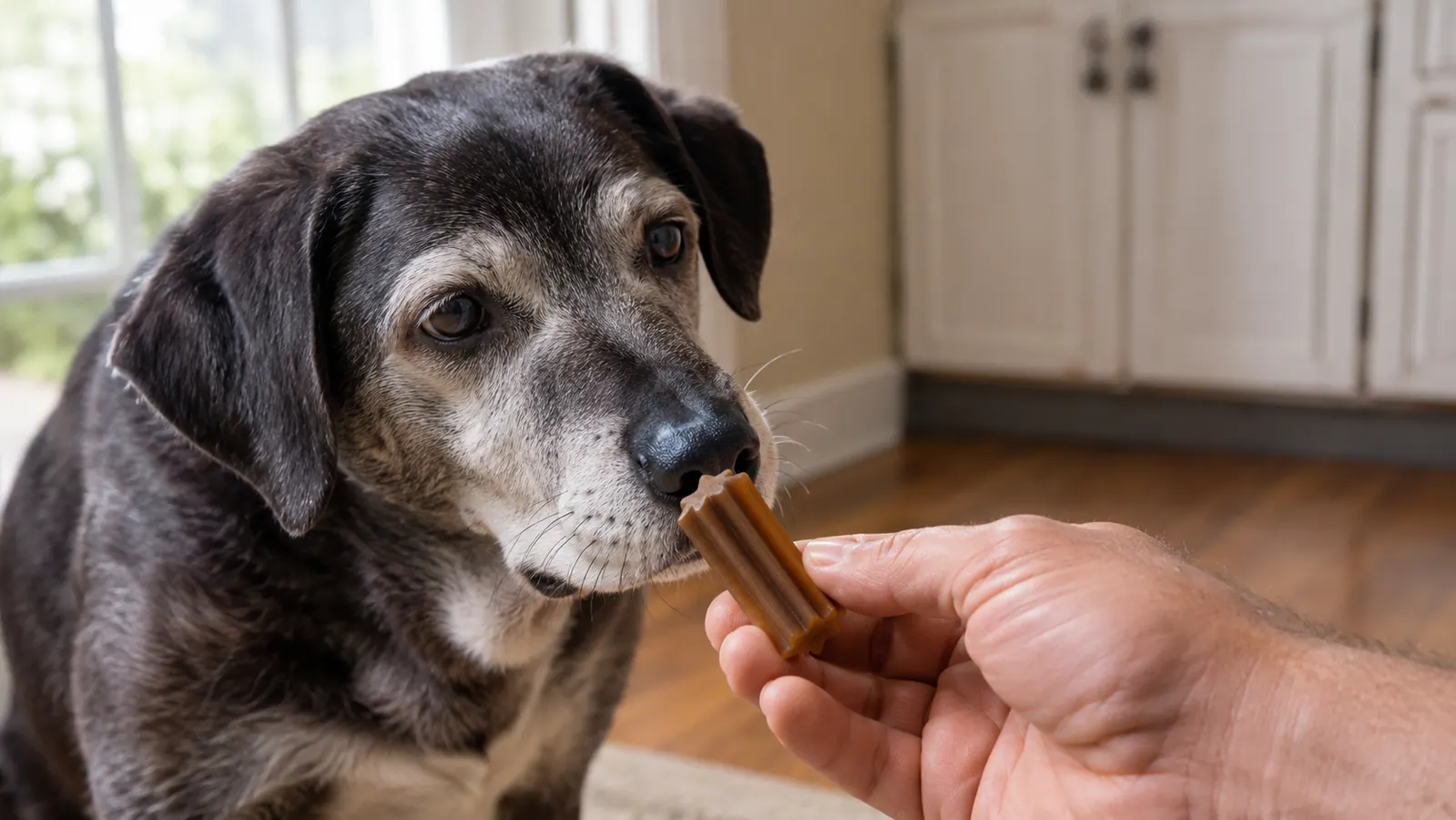
VetriScience Calm & Confident is the chicken flavored chew I keep in the pantry now, but it is only one part of the plan on this page. It is not a sedative, and it will not fix a dog who is in pain or bored out of her mind. Given daily for a few weeks, alongside the steps below, it took the edge off Juno's storm anxiety in a way nothing else had. Follow the label directions for your dog's weight.
Amazon Check Today's Price on Amazon →Step 1: Rule Out Pain Before You Treat Panic
I am going to start where I should have started two summers ago, and that is at the vet's office. A dog who is stiff and sore cannot get comfortable, and a dog who cannot get comfortable looks anxious. She paces. She pants. She whines at shadows. Before you spend money on calming chews, make sure the behavior you are calling anxiety is not a hip that aches when the pressure drops, a tooth that throbs, or ears that have gone dull with age. Juno has been stiff in the hips for a while now after years of trail miles, and when I finally brought up her storm panic, my vet checked her over head to tail before she said one word about her nerves.
Ask your vet the pointed questions, not the polite ones. Can she still hear normally, or does the storm reach her all at once because she cannot track it coming? Do her hips ache when the barometer falls? Is part of the restlessness actually pain she cannot tell you about? In Juno's case the answer was a clean bill aside from normal age stiffness, which meant I could stop wondering whether I was treating the wrong problem and start working on the anxiety itself.
The checkup also gave me a starting point. Juno was already showing her age in her hips, so we kept her on a joint routine. Tackling the anxiety meant treating the whole dog, and the vet visit is where that begins.
Step 2: Put the Day on a Boring, Repeatable Schedule
The cheapest fix in this entire guide costs nothing, and it was the one I resisted the longest because it sounded too simple to matter. I made the day predictable. Seniors lean hard on routine, and Juno is no different. When breakfast lands at the same time, the walk leaves at the same time, dinner is down by five, and the last trip outside happens at the same point in the evening every single night, the world stops being a series of surprises. Anxiety lives in surprise. Routine starves it.
I did not see how ragged our schedule had gotten until I wrote it down and looked at it honestly. Walks bounced around with my workday, dinner waited on whatever I happened to be doing, and bedtime meant whenever I turned off the lamp. Juno adapted, but adapting is work, and steady low grade work raises the baseline. These days her morning walk happens before my coffee and her dinner is on the floor by five. The point is not the exact times. The point is that the times do not move.
The routine matters twice as much on the days that feel chaotic. When a storm is forecast or company is coming, I keep the regular times anyway. The rest of the day can fall apart. The anchors hold.
Step 3: Build a Den, Not Just a Bed
The second change came from a failed experiment. For months I tried to comfort Juno where she stood during storms, petting her, murmuring to her, rubbing her chest. I learned the hard way that you cannot pet a dog out of a panic. She needed a place to go, not a person hovering over her. A dog who is overwhelmed will pace until she finds a spot that feels safe, and my job was to build that spot on purpose instead of letting her settle for the worst version of it.
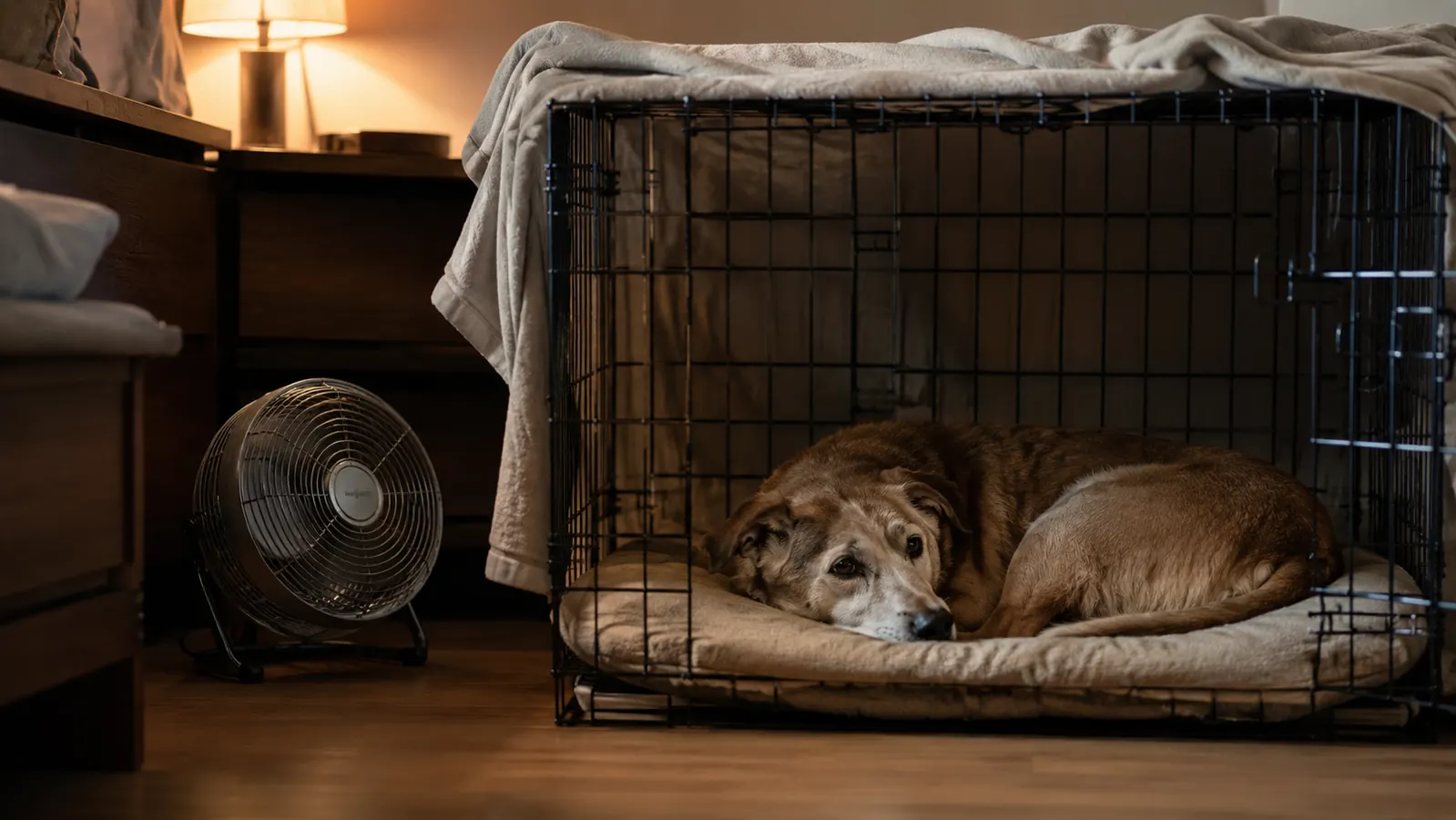
Juno's den is a wire crate in the corner of the bedroom with a blanket draped over the top and the back so it reads as a cave. A small fan runs beside it for white noise, and the radio stays on low during the day so quiet stretches do not feel strange. The crate door stays open. It is her room, not her jail. For a dog without a crate, the same idea works behind the couch, under a table, or in a closet corner with the door cracked. Cover it, muffle the sound, and make it off limits to the rest of the household.
The trick is to make the den a normal place before it is ever an emergency place. I spent a week dropping treats and chews into that crate when the sky was clear and nothing was wrong. By the time the next storm hit, it was already the spot she chose on her own, not a cage I shoved her into.
Step 4: Spend the Energy Before the Trigger Arrives
An anxious dog is very often a dog with a full tank of energy and no safe way to drain it. A young dog burns the edge off by running laps. A senior with stiff hips cannot do that, and the frustration comes out as restlessness and worry. I stopped trying to fix that with a frantic walk on the day of the storm and started doing the real exercise early, while the sky was still calm.
Our storm day routine now looks like this. The serious walk happens before lunch, slow and sniffy, with Juno's nose in charge of the route. Twenty minutes of serious sniffing works a dog harder than an hour of trotting, because smelling is thinking. Later, when the barometer starts to drop, she gets a lick mat with a thin smear of plain yogurt, which keeps her busy, low, and still for a solid stretch. I do not try to walk her once the storm is rolling in. She spends that whole walk tense from the first rumble, and tension compounds.
The point of all of it is to send her into the evening already tired and already calm. A tired dog still startles at thunder. But a tired dog settles back down much faster, and that is the whole ballgame.
Step 5: Add VetriScience Calm & Confident the Right Way
Now the supplement, and the mistake I made with it, so you can skip that part. For months I kept the bottle in the pantry and reached for it only when the sky turned green, hoping it would work like a fast pill on the night of the storm. That is not how it worked for us. I changed tactics and started giving VetriScience Calm & Confident every day, well before storm season got going, and I judged the results after a few weeks instead of after one bad night.
The label takes the guesswork out of dosing, with directions broken down by weight, so you are not left to invent your own math. Juno is 62 pounds, and I follow the amount the label calls for at her size and give her the chew once a day. The active ingredients are thiamine, L-theanine, and alpha-casozepine, which is a milk protein derivative. The chew itself is chicken flavored, so it goes down like a treat rather than a fight. I would rather give one chew a day for months than chase a panicking dog around the house once a month.
Here is what actually happened, with no exaggeration. The first storm after she started the daily chew, she still headed for her den, but the frantic pacing stopped after the first few rumbles instead of lasting two hours. By the third storm, she slept through the worst of the night. It did not knock her out. She still lifted her head at the loud cracks. The difference was that the edge was gone, and that edge was everything. I also need to say the chew was never enough on its own. On the worst nights, the den, the tired muscles, and the steady routine were doing as much work as the supplement.
One more honest note. A supplement is not a sedative, and if your dog is genuinely panicking, drooling, chewing through doors, or a danger to herself, do not try to manage that with a chew alone. That is a conversation for your vet, and there are prescription options for exactly that situation. The chew is a tool. The plan around it is the real fix.
What Else Helps
A few smaller things did not make the five steps but still earn their keep. When a storm wakes Juno at night, I do not rush to her and coo. I get up, let her out if she needs it, and go back to bed without a production. The fastest way to convince a worried dog that something is wrong is to act like something is wrong. My voice stays low and flat, and so does my energy.
Some people swear by pheromone plug ins, and I tried one for a season. I cannot tell you it did much for Juno, but it did not hurt, and plenty of owners report real results, so it is a reasonable thing to test in your own house. What worked better for us was plain white noise. The fan in her den does more to soften the boom of thunder than any gadget I have plugged in.
If your dog's anxiety shows up when you leave, keep the goodbye small. I practiced the most boring possible exit: keys, coat, door, gone. No sad face, no mothering tone, no lingering. Coming and going became the dullest part of the day, and that is exactly what a nervous dog needs it to be.
And one thing I have to remind myself constantly. Dogs read us the way we read the sky. On the nights I am jumpy about a storm, Juno is jumpy too. I do as much of my own calming as I do hers, and it shows up in her.
By the third storm on the daily chew, Juno slept through the worst of the night in her den, on her own, instead of pressed against my legs.
Start With the Five Steps, Add the Chew, and Give It a Month
If your dog is like Juno, no single item on this page will feel like enough on its own. That is the point. Calm is built from the boring details, and VetriScience Calm & Confident is the piece that finally tied the rest of it together for us. Start the routine first, add the chew daily, and judge the whole plan after a few weeks.
Amazon Check Today's Price on Amazon →